
Why Sound Quality Drops Toward the Centre of a Vinyl Record
This guide explains why audio quality decreases toward the centre of a vinyl record. It outlines the physics and how to improve playback by considering certain steps when mastering. It also answers common queries such as “What is inner groove distortion”, “Why inner tracks sound worse” and “How record speed affects sound”.
What causes inner groove distortion
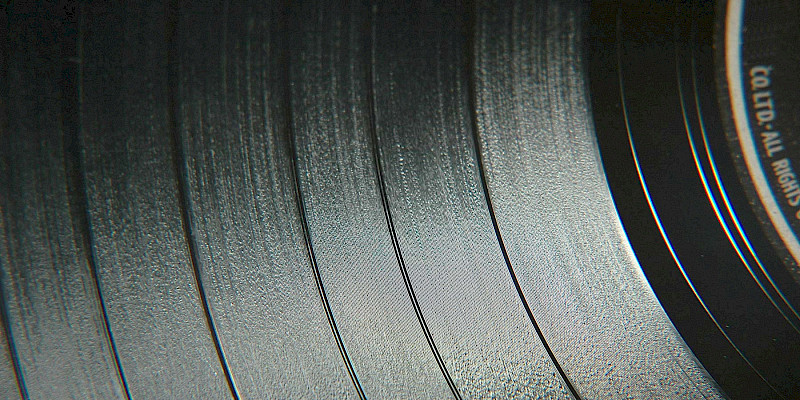
A stereo groove holds information on both walls at a 45 degree angle. The needle moves sideways (laterally) and vertically as it runs along the groove.
These movements are affected by the:
- Frequency
- Volume
- Groove spacing
- Tracking ability of the needle
Higher frequencies create short, fast movements, whereas lower frequencies create longer, slower ones. The difference between the quietest and loudest parts of a track is the called dynamic range. To reproduce this range, the needle needs enough space within the groove to track these changes. This is known as the tracking ability.
If the movement required is more than the needle can physically manage, distortion occurs and this is why careful mastering and cutting is critical. Mastering engineers set limits so the cutting stylus does not create a groove that some playback systems will be unable to follow.
How linear speed affects sound
A record player turntable rotates at a constant speed, so at 33⅓ rpm one full rotation takes about 1.8 seconds. However the distance the needle travels along the groove in that time gradually decreases as the record plays.
For a 12 inch record at 33⅓ rpm:
- At the outer edge (around 30 cm diameter), the needle travels about 94 cm per rotation.
- Near the centre (around 15 cm diameter), it travels about 47 cm per rotation
The linear speed halves so the length of groove travelled by the needle halves, however the same amount of sound information needs to fit into this reduced area. As a result the groove becomes compressed and the needle has less physical space to follow fast or detailed movement. This in turn can lead to:
- Less detail
- Increased distortion
- Reduced high frequency accuracy
- Reduced impact of loud passages
These effects increase as the needle approaches the centre of the record and is why inner tracks need more careful consideration when mastering.
Why mastering choices matter
Cutting engineers adjust the signal so the cutting stylus stays within physical limits. If the cut is too loud or contains strong high frequency material near the centre, distortion increases. Different turntables with a variety of cartridges and styli handle these limits in different ways, so a cut that tracks well on one system may struggle on another.
Good vinyl mastering and cutting aims to balance:
- Level
- Dynamics
- Track length
- Groove spacing
This improves tracking and reduces problems on standard turntables.
Tracking Angle and Playback Distortion
On most turntables the angle of the cartridge changes relative to the groove as the needle moves toward the centre. A cutting stylus always cuts perpendicular to the radius of the disc, but a pivoted tonearm does not play back at a fixed angle, so the difference between the cutting angle and playback angle becomes more pronounced toward the centre of the record. This creates:
- Misalignment between the groove walls
- Higher friction
- Stronger clamping effects
- More resonance
- Increased distortion
These factors combine with reduced linear speed to increase further the chance of audible change towards the centre of the record.
Why 45 RPM improves sound quality
Cutting at 45 rpm increases the length of groove per second which gives the needle more distance to track the same amount of information. The result is:
- Better high-frequency detail
- Lower distortion
- Stronger tracking performance
This is why 7 inch records, where the inner groove radius is small, are almost always cut at 45rpm. A 7 inch record cut at 33⅓ rpm performs poorly and is not advised. The reverse is also true and led to the development of 12" singles, popular with dance, hip-hop and reggae DJs. With just one track per side and by reducing the playing time it becomes possible to have a much wider frequency and dynamic range.
Conclusion
Understanding what causes the reduction in sound quality and increased risk of distortion toward the centre of vinyl records will help achieve the best possible results when mastering and cutting records. It may also influence decisions on choosing formats, between single, double or tripple vinyl, side splits, speed and even the sequence of tracks.
More articles from Breed
FAQs about Inner Groove Distortion
The linear speed drops near the centre, so the groove holds the same information in less distance. This increases distortion and reduces detail.
Yes. Higher speed increases groove length per second. This supports cleaner tracking and better high-frequency response, especially on 7 inch records.
How Breed Media Supports Better Sound
Sound quality is dependent on smart mastering and careful planning. We work with skilled cutting engineers who optimise each cut to maximise sound quality considering the limits of vinyl playback. Track order, level planning and cutting choices all play a part and should be planned in advance.
If you want guidance on mastering or optimal formats for your project, Breed Media guides you through every step to maintain sound quality from the moment the needle drops to the run out groove at the centre of your record.